For more than forty years, I have studied nutrition. I have read the literature, followed the research, and, above all, experimented with my own eating. That taught me the most. I could change what I ate or how much I ate, then observe how my body responded over time. Those years brought me to a simple conclusion. When it comes to how food shapes health over a lifetime, there are only two variables that count. The first is the quantity of food. The second is its quality.
Quantity
The first question of quantity is how to recognize enough. Food is meant to be enjoyed. Eating consciously means paying attention to how hunger changes during a meal and recognizing the point at which it gives way to satisfaction. At that point, a person can get up and put the rest of the food away.
This capacity is intrinsic to the human organism. As a person eats, the stomach and intestines send signals to the brain that help it register fullness. For our ancestors, hunger and fullness were part of the ordinary experience of eating. Food supplied the energy to hunt, build shelter, and carry on with the work of living. They ate without counting calories. The same bodily capacity is still there today. What many people have lost is the habit of paying attention to it.
People eat amid rushing, noise, and stress. Those conditions can make the signals of fullness easier to miss. The food itself also influences how much a person eats. In a controlled study, people ate more when offered an ultra-processed diet and allowed to choose how much to eat. What is on the plate can influence how much of it is eaten.
Modern life has turned the question of how much to eat into a multimillion-dollar business. Apps count calories, track grams of protein, fat, and carbohydrate, and estimate total daily energy expenditure, or TDEE. In 2020, the sale of MyFitnessPal alone was structured as a deal worth up to $345 million. When meeting a calorie target takes up a person’s attention at the table, it becomes easier to miss the moment when hunger has eased.
The practice begins with the meal already in front of the person. Eat consciously and with a purpose. Pay attention to how hungry the body is at the start, how that hunger changes, and when it has had enough. The purpose of the meal is to give the body the energy it needs to carry on with the day. If meals regularly leave a person feeling heavy, yawning, and wanting to lie down, that is a reason to look at how much they are eating.
Learning to recognize enough also means recognizing when the body needs more. A demanding day of training or physical work can call for more food than a quiet day. The same portion may satisfy a person one day and leave them hungry the next. Over weeks and months, the broader test is whether the amount a person usually eats gives them the energy to work, sustain their training, and recover from it.
Quality
The first measure of food quality is what the food is made of. Begin with a whole food that can be named by its main ingredient. Meat seasoned with salt or spices is still meat. A vegetable prepared with herbs is still a vegetable. Yogurt and kefir begin with milk, and fermentation gives them their distinctive character. In each case, the food itself remains recognizable. Its preparation serves the food.
The second measure is what the food provides. Protein, carbohydrates, and fat occur in very different proportions across whole foods. Even a piece of fruit can contain a trace of fat. The presence of a nutrient tells us what is there. The amount in a serving tells us what the food contributes. The same question applies to fiber, vitamins, and minerals. A food’s nutritional value becomes clearer when we consider how much of it a person eats and how often.
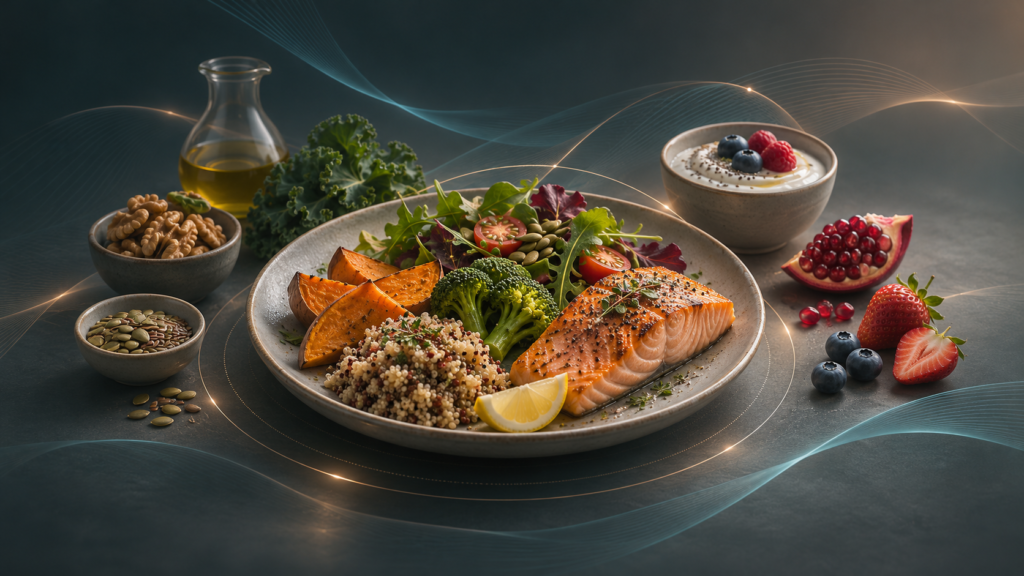
Nature provides whole foods whose contributions complement one another. Meat provides protein and nutrients such as vitamin B12 and zinc. Vegetables provide carbohydrates, fiber, vitamins, and minerals. Yogurt and kefir supply high-quality protein and calcium and can also provide live cultures. Walnuts supply a plant form of omega-3, while oily fish provides protein and other forms of omega-3. Each food has a particular contribution. Together, these foods can nourish the body in ways that any one food alone cannot.
That relationship is lost when so-called experts turn a single category of food into an entire philosophy of eating. “Eat just meat.” “Eat just plants.” “Eat just fruit.” The human organism has a range of needs, and the value of variety lies in how those needs are met across the diet. Vegetables, including tubers, along with grains, legumes, nuts, eggs, fish, meats, dairy, seeds, and fruit offer nearly endless ways to put meals together. A person can draw from that variety over days and weeks, letting the foods complement one another over time.
The balance changes with the demands of life. A period of hard physical work or training can change what the body needs to sustain effort and recover. Illness can change which foods serve the body and in what amounts. Here quantity and quality meet. The body’s circumstances help determine both what belongs on the plate and how much of it belongs there.
Modern life has made this ordinary act of choosing and combining food seem far more complicated than it needs to be. People who sincerely want to eat well face a flood of conflicting rules, confident claims, and promises that can mislead them. When deciding what to eat becomes exhausting, a packaged meal offers an immediate answer. Convenience is precisely what it sells. Yet a meal can begin with a few recognizable whole foods chosen for what they provide and how they complement one another. The question is what will nourish the body for the life it is living now.